Step Outside the Circle: Robert Greene on Finding the Sublime in Ordinary Attention
Robert Greene tells Andrew Huberman that awe isn't a trip you take but a doorway out of habit. His circle of consciousness, self-remembering, slowing your frame rate and falling in love on purpose, with his history and science claims checked.
If your weeks have started to feel like copies of each other, Robert Greene thinks the problem may not be your life. It may be the shrinking circle you see it through. In a long conversation with Andrew Huberman about his book The Law of the Sublime, Greene argues that awe isn't something you have to fly somewhere to find. It's in your backyard, your coffee cup and the person next to you, waiting for your attention.
In short: Greene describes everyday consciousness as a circle that tightens with age and habit, and "the sublime" as the jolt, part fear and part pleasure, of glimpsing what lies outside it. His ways out are deliberate attention, slowing your sense of time, living an experience instead of recording it, and letting yourself fall in love. The talk is mostly stories, and some of the history needs correcting.
1. A circle that shrinks, with doorways in the rim
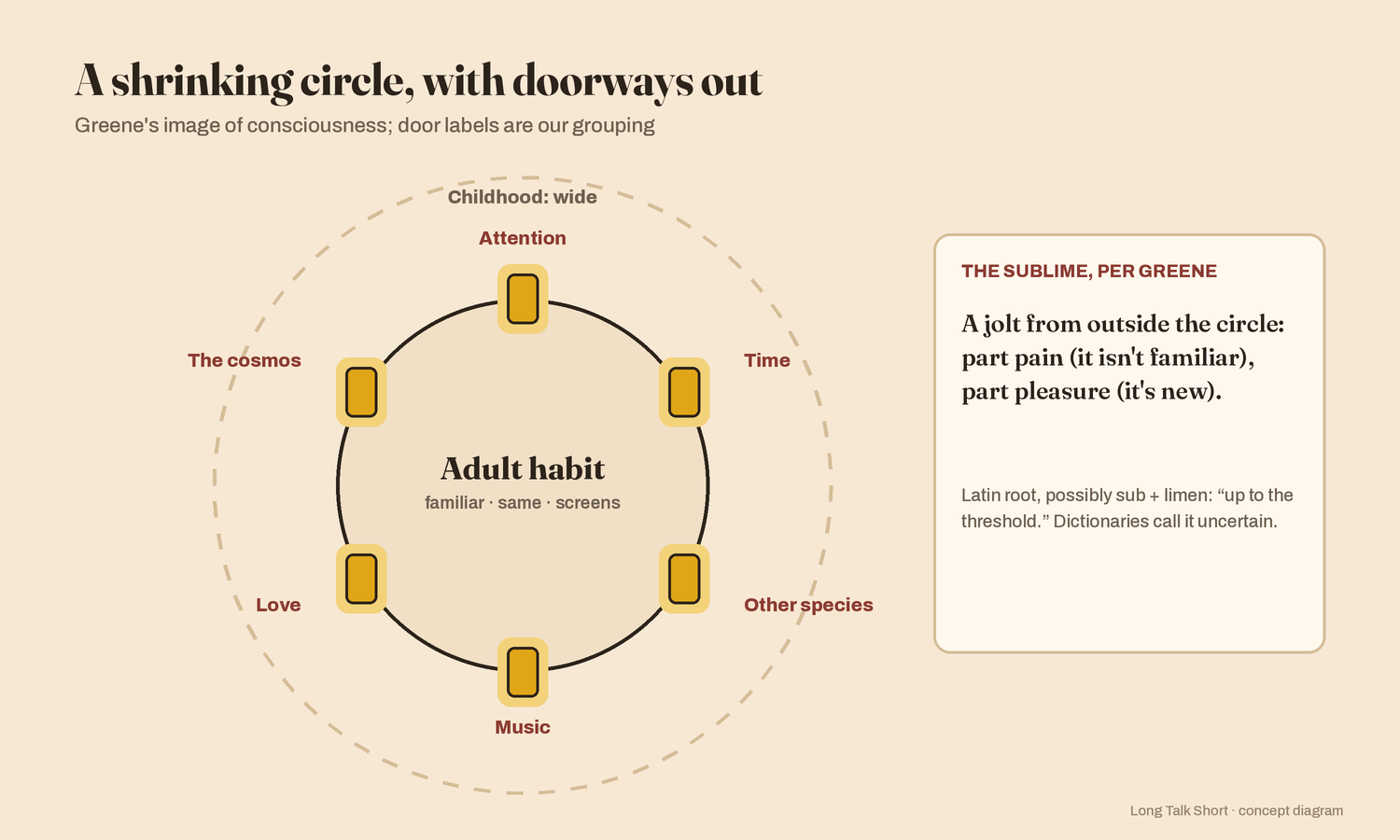
Greene pictures consciousness as a circle that holds your habitual thoughts, emotions and sense of what is real. In childhood it's wide, because everything is unfamiliar. With age it "gets smaller and smaller," until even a holiday or a mountain climb fades within days.
The sublime, in his telling, is a series of doorways in the edge of that circle. He notes that the word may come from the Latin for "up to the threshold." Stepping towards one is both unsettling and thrilling, and that mix of pain and pleasure is how he defines the feeling. So where did he find his own doorway?
2. The view from a hospital window
Having once planned a book around adventures like ayahuasca, he had a stroke. The day after it, looking out of a hospital window, he found the sky, the clouds and the swaying trees suddenly "insane" in their beauty, as if he had just been born. When the feeling faded, he found it again in his small backyard.
His conclusion is that the sublime "is part of our everyday life," and that the need for it is as basic as shelter or companionship.
3. Attention is the doorway you control
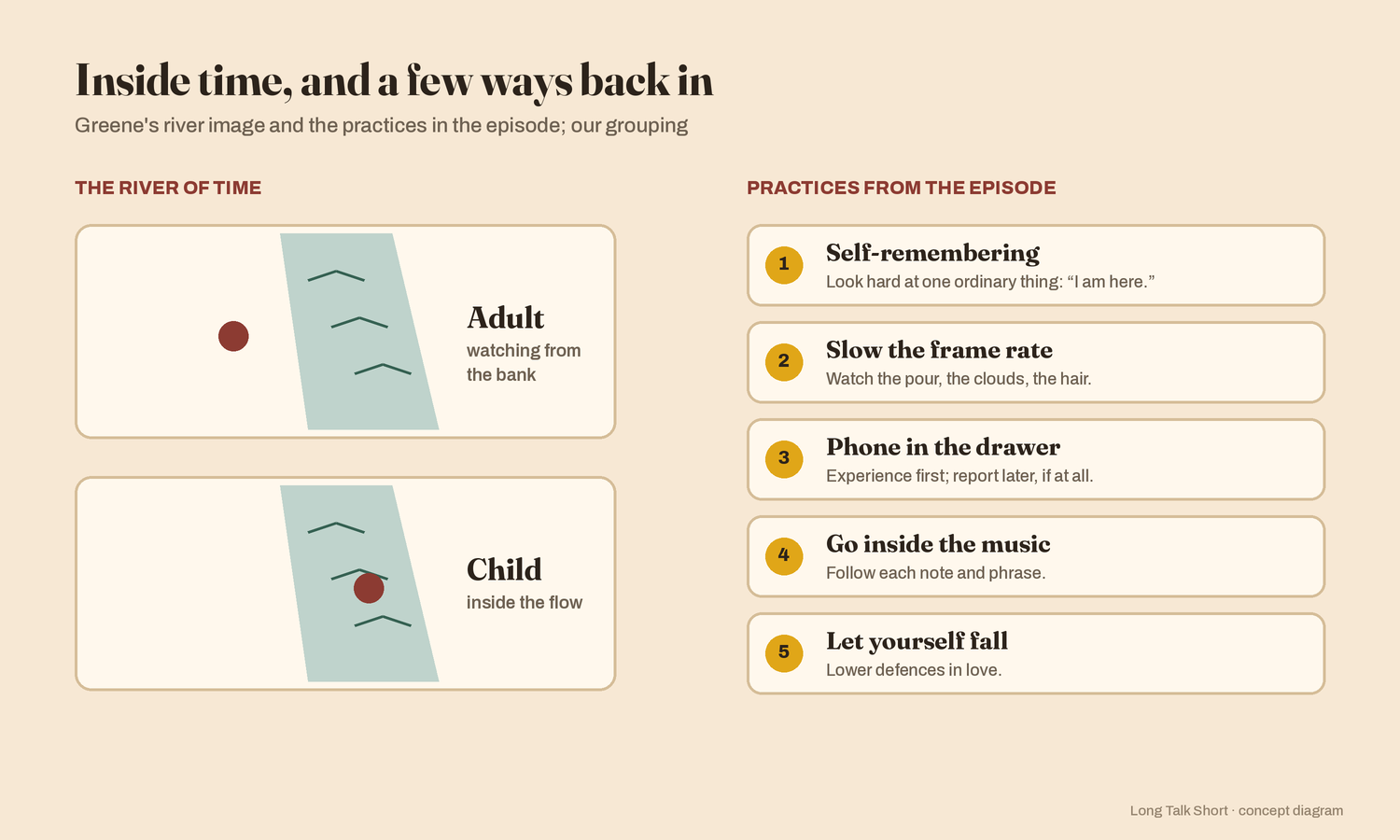
His main tool is attention. Greene retells the method of the mystic G.I. Gurdjieff, who taught that most people sleepwalk through life, and his practice of "self-remembering": look hard at something ordinary while telling yourself you are here, and that you will remember this.
Gurdjieff's student P.D. Ouspensky practised on a vase of flowers until ordinary houses seemed alive. Then, on a walk, he lost the thread at a tobacconist's and "woke up" hours later across town. The lesson Greene takes is that you don't notice how asleep you are until you've been fully awake.
Huberman notes that the nervous system mainly registers change. Greene's version is the painter Cézanne staring at one apricot tree, refusing to see just the category "tree". This isn't fantasy, he insists, but "seeing things as they are" before your brain files them under familiar labels. But attention also has a speed.
4. Change your frame rate
Most of us, Huberman says, live at one "frame rate". You can slow it down by watching an espresso pour, or widen it by lying on the grass watching the clouds.
Greene answers that childhood felt rich because there was "space between thoughts". Adult attention, he says, is "broken up into millions of little splinters". He describes a child as standing inside the river of time and an adult as watching it from the bank, and he uses 40 minutes of daily meditation to step back in.
His examples include Vladimir Nabokov rebuilding his lost Russian childhood in Speak, Memory, the geologist Albert Heim feeling seconds stretch during a fall, and a diver who befriended an octopus.
5. Live it, don't report it
Both men think the urge to record and share everything works against this. If you film the mountain while you climb it, Greene says, "you're not experiencing the mountain itself."
He wrote the book by hand over seven years, filling more than a hundred notebooks with fountain pens because his left hand still doesn't work properly, and he says the slowness changed how he thought.
6. Falling, on purpose
The most personal part of the conversation is about love. "Falling in love" is apt, he says, because falling involves fear. Most people stop halfway, afraid of being abandoned, and the other person senses it and stops too. He calls letting your defences down "a form of rebellion" against a cynical culture.
Weighing it: what holds up
Framing: "Live your best life" is the show's promise. The talk offers a handful of practices, but it's mostly stories. Greene is promoting his book. The outro calls it The Art of the Sublime; the publisher's title is The Law of the Sublime.
Holds up: Heim did survive an 1871 fall and in 1892 published accounts from fall survivors describing time stretching and their lives flashing before them. Dictionaries do list "up to the threshold" as one possible origin of "sublime", but they call it uncertain.
Partly holds: Ouspensky's own account broadly matches Greene's version, though he woke after two hours, not three.
Corrections: Nabokov's father was shot in Berlin in 1922 while shielding another politician from Russian monarchist assassins, and his mother died in Prague in 1939, not Berlin. His brother did die in the Neuengamme camp. The octopus film is My Octopus Teacher; common octopuses live roughly 12 to 18 months, not three years, and the friendship lasted about a year. Greene admitted his figure that 85% of near-death experiences are positive was a guess; reviews put distressing ones at roughly 11 to 23%, though this research relies on self-reports. His statement that meditation is "proven" to rewire your brain goes too far: two randomised trials published in 2022, with 218 participants, found no structural brain changes after eight weeks of mindfulness training.
Not checked: his link between right-side strokes and heightened emotion, the idea that language evolved from music, and the athlete anecdotes.
Disclosures: We worked from YouTube's automatic captions, a machine transcript so quotes may contain small mistakes. The episode carries ads for David, Eight Sleep, AG1, Element and Function. Huberman calls himself a longtime fan of Greene.
Bottom line: the attention practices are simple and worth trying. Treat the history as colourful rather than exact, and the brain-rewiring claim as overstated.
Related reading: People Are Patterns: Robert Greene's Laws of Human Nature (a separate piece on a different Greene book) · More Pleasure, Less Joy: Anna Lembke's Dopamine Nation · Viktor Frankl's Man's Search for Meaning: the freedom no one can take
Long Talk Short
- Greene describes everyday consciousness as a circle that shrinks with habit, and the sublime as the unsettling, thrilling glimpse beyond it.
- His main tool is attention: look at something ordinary until the label falls away.
- Filming an experience for others can stop you from having it.
- Some of his history is off, and his claim that meditation is proven to rewire the brain goes too far.
The one thing to remember: the world probably isn't as dull as it seems. Your attention is probably narrower than you think.
This summary is general information, not medical or mental-health advice. If you have health concerns, including after a stroke, see a doctor. If you are in crisis, call or text 988 (the Suicide & Crisis Lifeline in the US) or contact local emergency services.
Source: Andrew Huberman with Robert Greene, "Access the Sublime & Live Your Best Life," Huberman Lab, on YouTube. This is an independent summary and is not affiliated with Huberman Lab or Robert Greene.