The Eight-Week Window: Robert Pape's Escalation Trap Thesis, Checked
You might think election risk ends on voting day. Political scientist Robert Pape argues the weeks before the incoming Congress sits are the real danger, because wars escalate like losing bets. His theory, his firebreaks, and what checks out.
If you think the danger of an election ends when the votes are counted, Robert Pape argues the opposite. On The Diary of a CEO, the University of Chicago political scientist says the stretch between a midterm vote and the seating of the incoming Congress could be the riskiest stretch of the year. His reason is that three pressures could peak at once: political violence at home, escalation in the Iran war, and a winter push by Russia in Ukraine. It is a forecast built on a theory of how wars escalate, and it should be read as one.
In short: Pape's core idea is an "escalation trap": military strikes can succeed on paper while handing the weaker side more leverage, which pushes leaders to raise the stakes rather than cut their losses. He applies it to the Iran war and adds domestic and Ukrainian risks to argue the transition period is unusually fragile. He proposes three "firebreaks" to slow things down. His predictions are conditional and unresolved; several of his specific facts are off.
1. The escalation trap
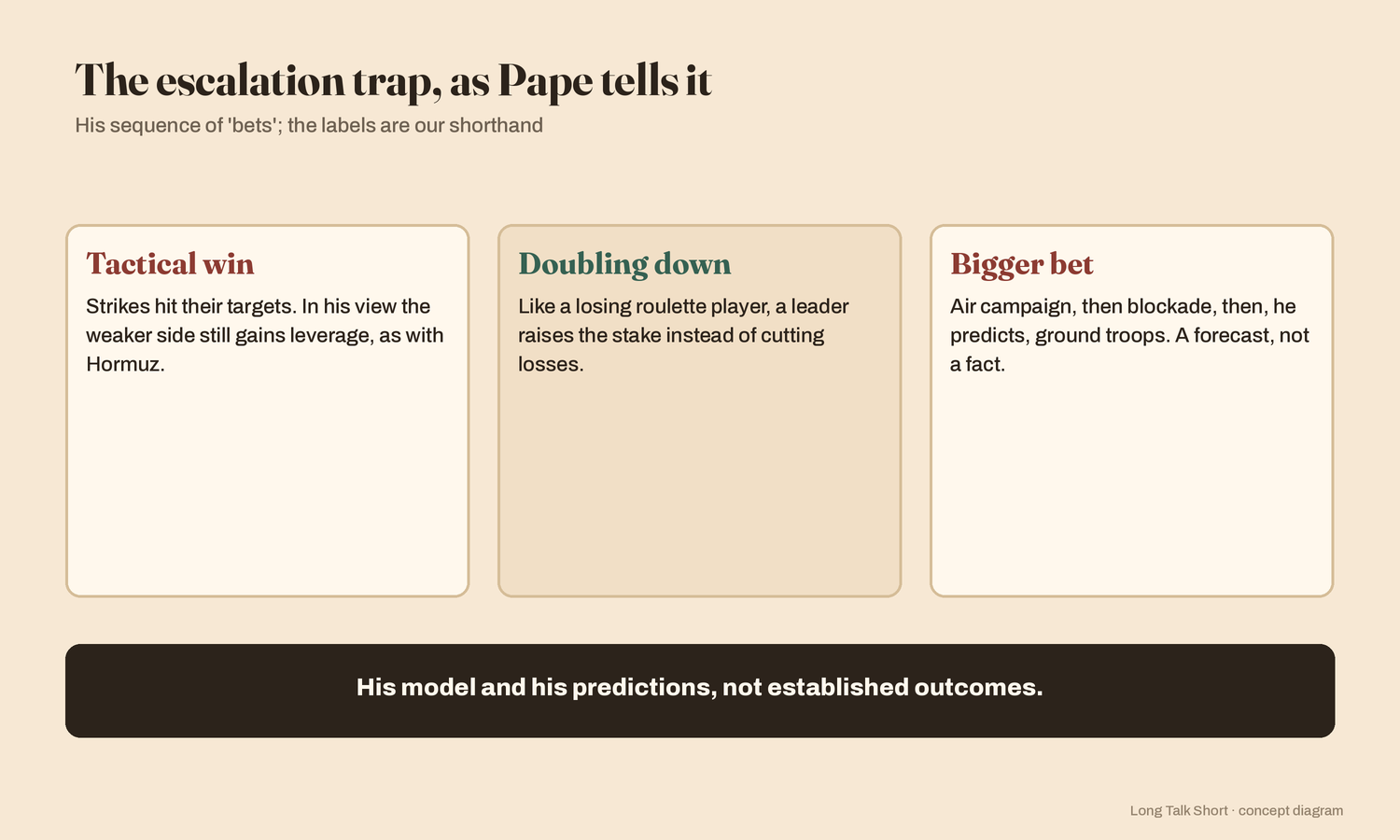
Pape's career has been spent studying air power, suicide terrorism and political violence, and his central claim draws on that work. Bombing, he argues, often achieves its tactical goals and still fails strategically. In the Iran war, he says, strikes hit what they were aimed at, yet Iran's ability to threaten shipping through the Strait of Hormuz gave it more bargaining power, not less.
His analogy is the difference between chess and roulette. In chess, you lose and learn. At the roulette table, a losing player doubles the bet to win back what is gone. Pape describes the war as a series of such bets: killing Iran's Supreme Leader, an extended air campaign, then a blockade he expects to stretch for months. The next bet, in his forecast, is US ground troops, followed by a long war. He compares the pattern to Lyndon Johnson in Vietnam.
On why leaders keep raising the stake, Pape offers legacy as a motive and, more speculatively, financial losses tied to the president's family's crypto ventures. That is his reading of intent, not something he documents. He also argues that the White House's "three-day plan" resembles Instant Thunder, the planned short air campaign that opened the 1991 Gulf War and grew into weeks of bombing.
2. Why the transition, specifically
The window matters, in Pape's account, because authority is blurry. A lame-duck Congress has little incentive to restrain the executive, the incoming one has not taken office, and adversaries may read the moment as a chance. He layers three threads on top of each other.
At home, he points to his own center's polling on what he calls violent populism. Abroad, he expects Iran's leadership, weakened by strikes, to become harder to negotiate with because no one can deliver a deal, and he warns of decentralized retaliation and "inspired" attacks. He cites an incident on a Dubai to Tel Aviv flight, which he judges 75 to 90% likely to have been terrorism. In Ukraine, he argues Vladimir Putin wants the rest of four regions and is planning a winter campaign against power grids in Kyiv, Kharkiv and Odesa.
His most speculative thread concerns a power and water outage in Minnesota. He says an NYT story attributed it to Iran, citing US intelligence, and infers the story was played down. We did not verify the report or the attribution, and the inference about suppression is his.
3. His proposed firebreaks
Pape ends with three steps he thinks could slow escalation. First, members of both the outgoing and incoming Congress would publicly commit to no further Iran escalation until the incoming Congress is seated, unless Iran attacks first. Second, governors and mayors would call for a pause of about two months on deploying federal armed agents in cities. Third, mediators such as Pakistan, Qatar and India would press all sides to keep civilians off-limits. He advises listeners not to stockpile goods, and to contact their representatives instead.
Weighing it: what holds up
Framing: "The 8 Weeks After Midterms Could Be The Most Dangerous!" is a forecast presented as a headline. Pape argues the case; nothing in the episode shows it is so. His darkest scenarios, including a wider European war, are possibilities he raises, not likelihoods he quantifies.
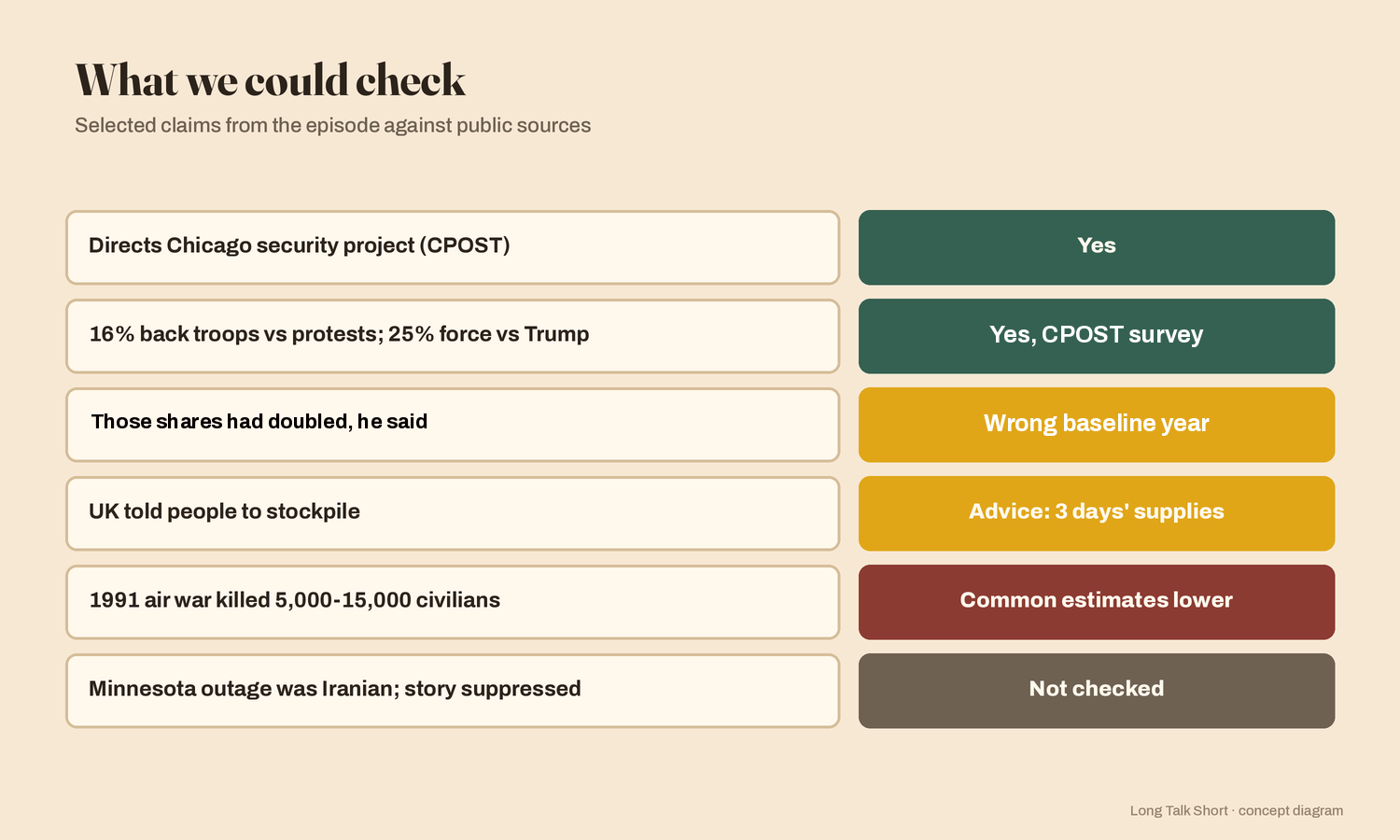
Holds up: Pape directs the University of Chicago's Chicago Project on Security and Threats (CPOST) and has written books on air power, suicide terrorism and political violence, including a book on violent populism. A CPOST survey did find about 16% of Americans support the president using the military to suppress protests and about 25% support force to stop him being president.
Partly holds: He said those figures had doubled from a baseline that did not match CPOST's comparison point. A separate UC Davis study found support for political violence declining, a counterpoint he did not mention. The UK's Be Ready campaign advises households to keep about three days of supplies, including three liters of water per person per day. That is advice, not an order to "stockpile."
Corrections: Pape put civilian deaths in the 1991 air campaign at 5,000 to 15,000. Commonly cited estimates of direct civilian deaths are lower, in the low thousands, though counts that include later effects run higher. He claimed his previous appearance on this show helped avert a planned drone campaign; that is unverifiable. Asked whether the White House has contacted him, he said only that people in power have.
Not checked: We did not verify the Tel Aviv flight incident, the Minnesota report, the Houthi casualty figures, his Russian casualty estimates or the president's reported remarks on the Insurrection Act. Motives he attributes to officials are his interpretation. Quotes were checked against YouTube's automatic captions, a machine transcript.
Disclosures: The episode carries ads for Fiverr and for a ketone drink the host co-owns, and an ad for Grok Bot, made by a company the host says he has invested in. This summary was prepared with Grok Bot, so readers should know about that tie. The figure groupings are ours. This piece is distinct from our other coverage of the war: it concerns escalation dynamics, not religious motives.
Bottom line: a coherent theory of escalation applied as a conditional forecast; treat the calendar warning as one scholar's scenario, not a prediction you can bank on.
Related reading: Jiang Xueqin's end-times theory of the Iran war, checked · Mohamed El-Erian on the Iran war and oil · Sarah Paine on why the sea beats the land
Long Talk Short
- Pape argues that strikes can win tactically while giving the weaker side more leverage, which tempts leaders to escalate.
- He sees the gap between the midterm vote and the incoming Congress as a period when restraint is weakest.
- His polling figures check out, though his baseline date was wrong and contrary research exists.
- His forecasts, from ground troops to a wider war, are conditional and unresolved.
- His three firebreaks are concrete: a congressional pause, a local moratorium on federal agents, and third-party mediation.
The one thing to remember: when a side keeps "winning" but the conflict keeps growing, ask whether the next step is strategy or a bet to recover losses.
This summary is for general information only and is not political, military or investment advice. Forecasts about war and violence are contested and unresolved.
Source: Steven Bartlett and Robert Pape, "Iran War Expert: 'The 8 Weeks After Midterms Could Be The Most Dangerous!' | Prof Robert Pape," The Diary of a CEO, on YouTube. This is an independent summary and is not affiliated with The Diary of a CEO or Robert Pape.