Not Willpower, a New Link: Tony Robbins's Pain-and-Pleasure Switch, and How Far Research Backs It
A food that once made you sick can repel you for years, with no willpower needed. Tony Robbins says the same switch, from pleasure to pain, drives every change. We check it against research on taste aversion, fear messages and habits.
Think of a food or drink you once loved and can't stand any more, because one bad night left you sick. You didn't decide to stop wanting it, and you didn't need discipline. It just stopped tempting you. In a short clip shared on X, Tony Robbins says that switch is the key to every change you've struggled to make.
In short: Robbins argues that people change when they link enough pain to staying the same, or enough pleasure to changing, and that these links live "in your gut," not your head. Research backs his main example; applying it on purpose to other habits is much less proven.
1. Leverage, not willpower
The clip opens with a seminar question: can you change someone who doesn't want to change? Robbins says yes, with enough "leverage," meaning a reason that makes change a must. It differs by person: children for some, spiritual growth for others. For some, he says, not even their own life is enough.
What works, in his telling, is leverage that makes people make themselves do it, plus interrupting the old pattern until another one shows up. So where does that leverage come from? His answer starts with your stomach.
2. The switch you've already felt
Then comes the example behind the clip's title. If a favourite dessert or drink once "went down but kept coming back up," just the thought or smell of it may still repel you.
Was that a change in willpower?
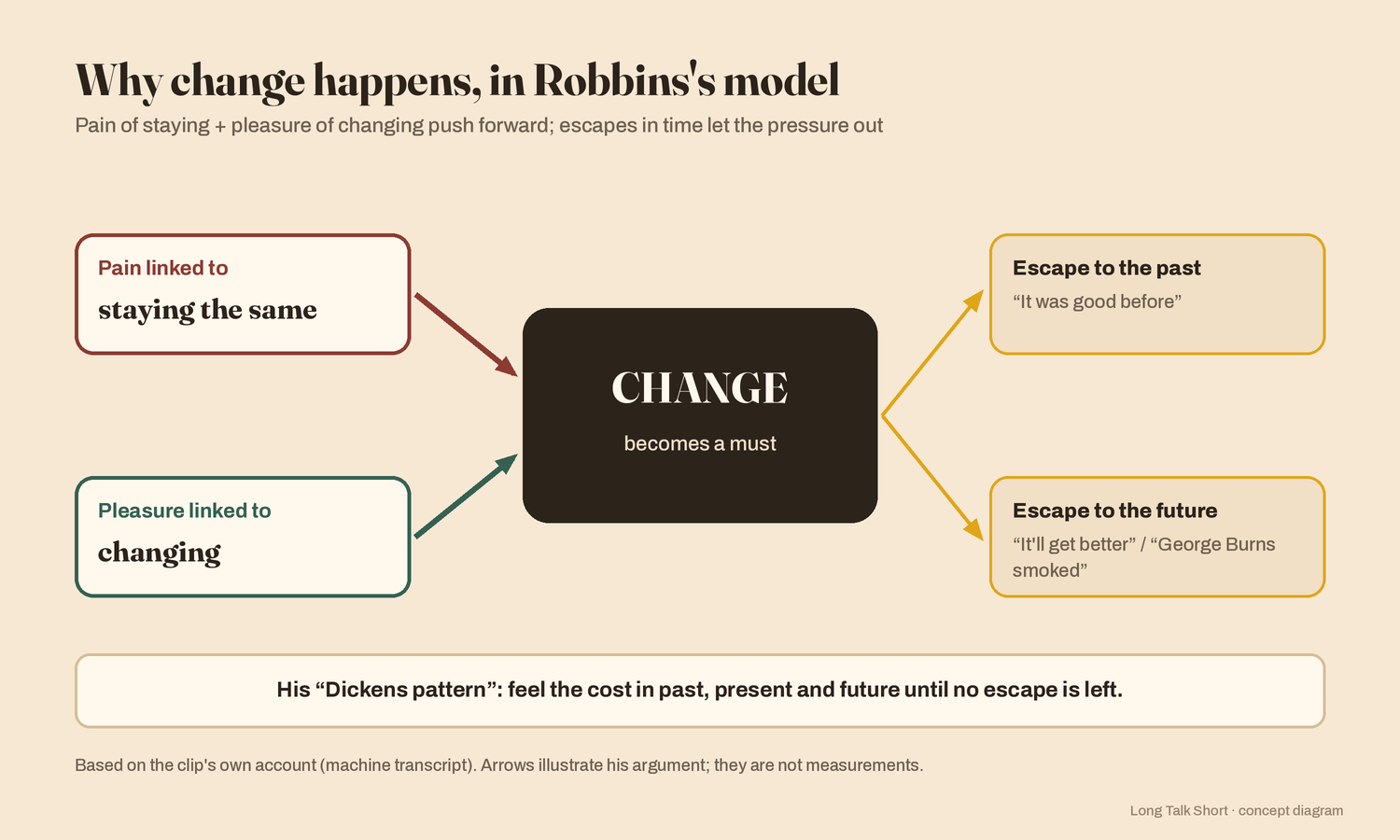
No, he answers: your brain moved that food from the pleasure column to the pain column. He calls this a "neuro-associative" change. Nothing about your character changed; the link did.
The problem, he says, is that many of us have the links backwards. We link pain to things we need, such as exercise or a relationship, so we avoid them. Your job, in his view, is to rewire what you link pain and pleasure to. Knowing what you should do isn't enough when "your gut takes over" at the moment of choice. But if the links are that powerful, why do so many people stay stuck?
3. Why people stay stuck: escape routes in time
Robbins's answer came to him, he says, while watching A Christmas Carol late at night after a seminar. Scrooge linked people with pain and believed his meanness made him rich. Then, in one night, "three neuro-associative conditioning specialists" (the ghosts) made him feel pain about his past, present and future until there was "nowhere to escape."
That, Robbins says, is the second reason people don't change: they escape in time. A painful relationship gets excused by remembering how good it used to be. A smoker's cough gets excused by an imagined future, because George Burns smoked cigars and lived to be very old.
People change, he argues, when the past was painful, the present is painful and the future looks worse. He calls this the "Dickens pattern": wall off all three escapes, and "amazingly, you'll move forward." It's a vivid story. How much of it survives contact with the research?
Weighing it: what holds up
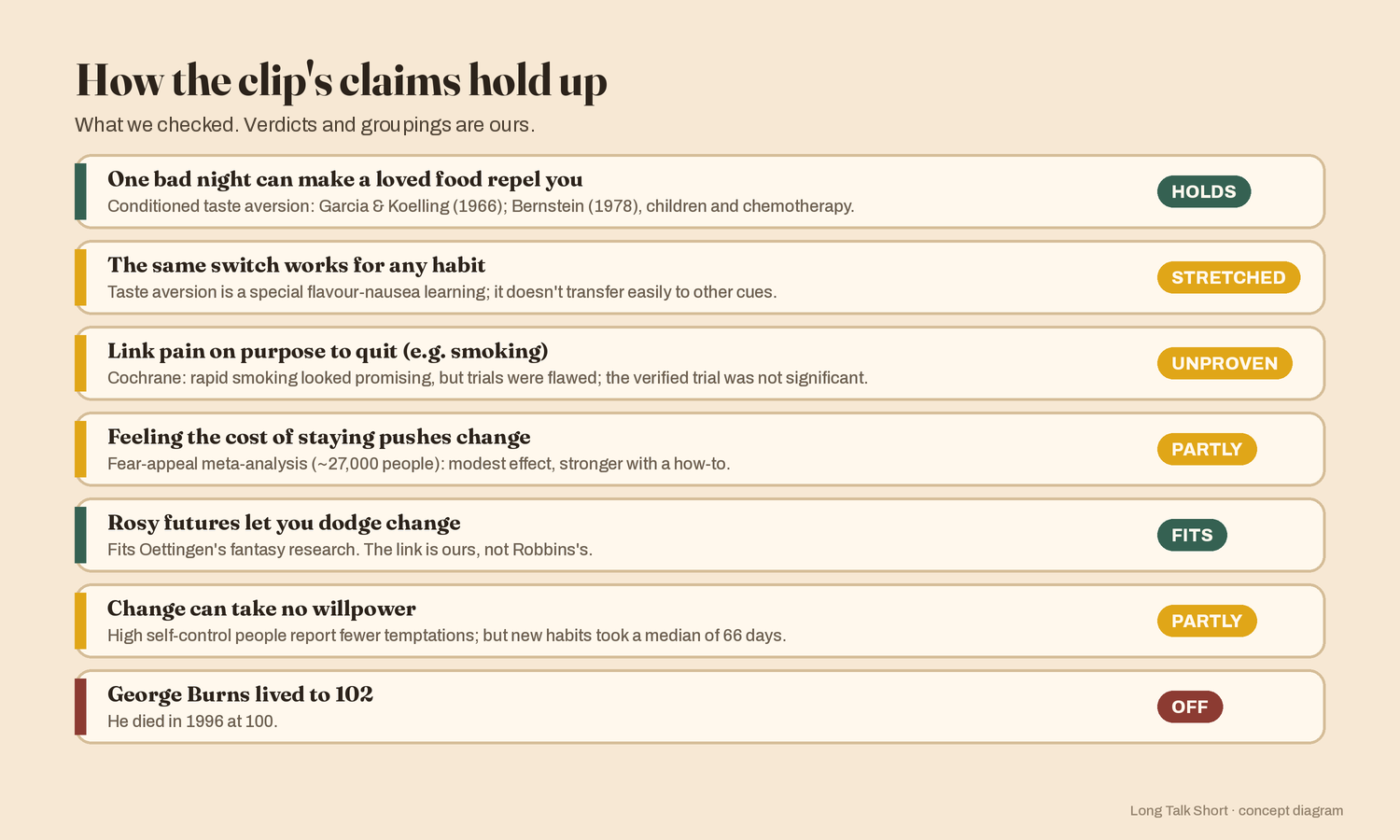
Holds up: The taste-aversion example is real; psychologists call it conditioned taste aversion. We checked two classic studies. Rats in Garcia and Koelling's 1966 experiment learned to avoid a flavour followed by sickness. In Ilene Bernstein's 1978 study, children who ate an unfamiliar ice cream before nausea-inducing chemotherapy mostly avoided it weeks later. Her paper notes such aversions can form after a single pairing.
Stretched: The jump from food to everything else is weaker. Taste aversion is a special kind of learning between flavour and nausea; Garcia's work is known for showing it does not form as easily with other cues.
Unproven: Deliberate aversion therapy has a mixed record. A Cochrane review we checked found "rapid smoking" (puffing until it feels awful) looked promising but rested on flawed trials; the one trial that verified quitting biochemically found no significant effect.
Partly supported: Feeling the cost of not changing can help. A 2015 meta-analysis we checked (about 27,000 people) found fear-based messages modestly shifted behaviour, more so when they also said how to act. His point about escaping into the future echoes Gabriele Oettingen's research, which found rosy fantasies predicted less effort and worse results. That link is ours; Robbins doesn't cite it.
Partly supported: "No willpower" has some backing. In a 2012 study we checked, people high in self-control reported fewer temptations rather than more resisting. But habits take time. In Lally's 2010 study, a daily behaviour took a median of 66 days to become automatic, ranging from 18 to an estimated 254. Not every change is a one-night switch like Scrooge's.
Off: Two facts in the clip are wrong. George Burns died in 1996 at 100, not 102. And in Dickens's story the ghosts don't show Scrooge only pain; they also show him past joy, such as Fezziwig's Christmas party.
Disclosures: Robbins sells this method. "Neuro-associative conditioning" is his own branded system, and the clip appears to come from one of his seminars. His four-day Unleash the Power Within event lists a virtual pass at $545 on his site, which also cites a study of attendees we did not review. The account that shared the clip, @furiokao, gave no event name or recording details, so we couldn't confirm where it was recorded. Quotes come from a machine transcript (faster-whisper) and may contain small errors.
Bottom line: The pleasure-to-pain switch is real, but it is strongest for food and sickness. As a general method it is a useful frame, not a proven technique, and most habits still take weeks or months.
Related reading: The Marshmallow Test Was Never About Willpower · More Pleasure, Less Joy: Anna Lembke's Dopamine Nation · Make Room Before You Add More: Ed Mylett
Long Talk Short
- Robbins says change runs on leverage: a reason strong enough that changing becomes a must, and it differs by person.
- His proof is the food that once made you sick: it took no willpower to stop wanting it, because pleasure turned into pain.
- People stay stuck, he says, by escaping to a nicer past or an imagined future. His "Dickens pattern" closes those escapes.
- Taste aversion is well documented, but deliberately creating aversions has a mixed record, and most habits take weeks or months, not one night.
The one thing to remember: you may not lack willpower. You may be linking pain to the thing you need and comfort to the thing that's hurting you, so be honest about what staying the same will cost.
Source: a clip of Tony Robbins shared on X by @furiokao. The original event is not identified. This is an independent summary and is not affiliated with Tony Robbins or the account that shared the clip.
This article is for general information only and is not medical or psychological advice. If you are struggling with addiction or your mental health, talk to a doctor or qualified professional, and if you are in crisis, call or text 988 (the Suicide & Crisis Lifeline in the US) or contact local emergency services.