When Pretend Empathy Feels Like Enough: Sherry Turkle on Chatbot Friends
You might find texting easier than calling. Sherry Turkle says that habit leads straight to chatbot friends, which offer a performance of empathy that starts to feel like enough. Her argument, Sam Harris's pushback, and what checks out.
If you have ever preferred to text rather than call, Sherry Turkle thinks you already know the first step toward chatbot companionship. Talking with Sam Harris, the MIT sociologist and psychologist, who has interviewed people about their relationships with technology for decades, argues that AI companions are less a fresh problem than the end point of an old one: a steady retreat from the vulnerability that human relationships require.
In short: Turkle's claim is that chatbots offer a performance of empathy, and the danger comes when that performance starts to feel like enough. Along the way, she argues, people lose tolerance for solitude, boredom and the friction of real relationships. Harris pushes back on whether a sufficiently convincing machine would be worse than an imperfect human. The clip is an excerpt of a longer conversation.
1. From talking to each other to talking to machines
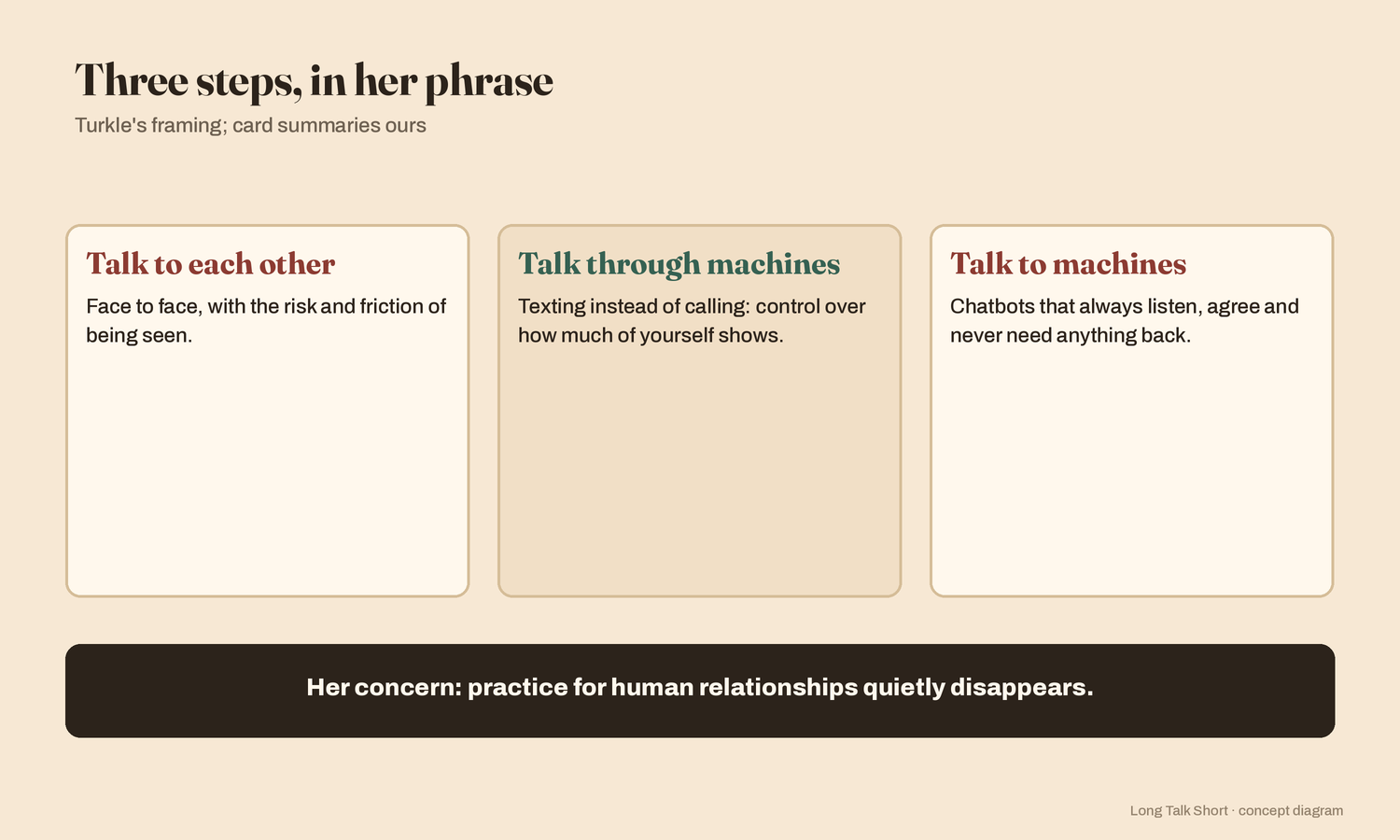
Turkle compresses her argument into three steps: first we talked to each other, then we talked to each other through machines, and then we talk to machines. Each step, in her telling, gives more control over how much of ourselves we expose. Texting lets you edit; a chatbot never judges, never gets bored and never needs anything back.
She stresses that none of this is built into technology itself. She recalls an early personal-computing ideal she attributes to Lee Felsenstein: use the virtual to improve the quality of life in the real. What changed, she argues, is a business model. An attention economy that profits from anger and silos built social media, and companion bots fit the same logic.
This is where Mark Zuckerberg comes in, briefly. Turkle paraphrases him as saying people want about 15 friends but have two or three, so Meta can help fill the gap with chatbots. For her, that captures the problem: treating loneliness as a supply shortage that software can fix. Loneliness, in that framing, becomes a market gap rather than a call for harder, riskier human contact.
2. What she says we lose
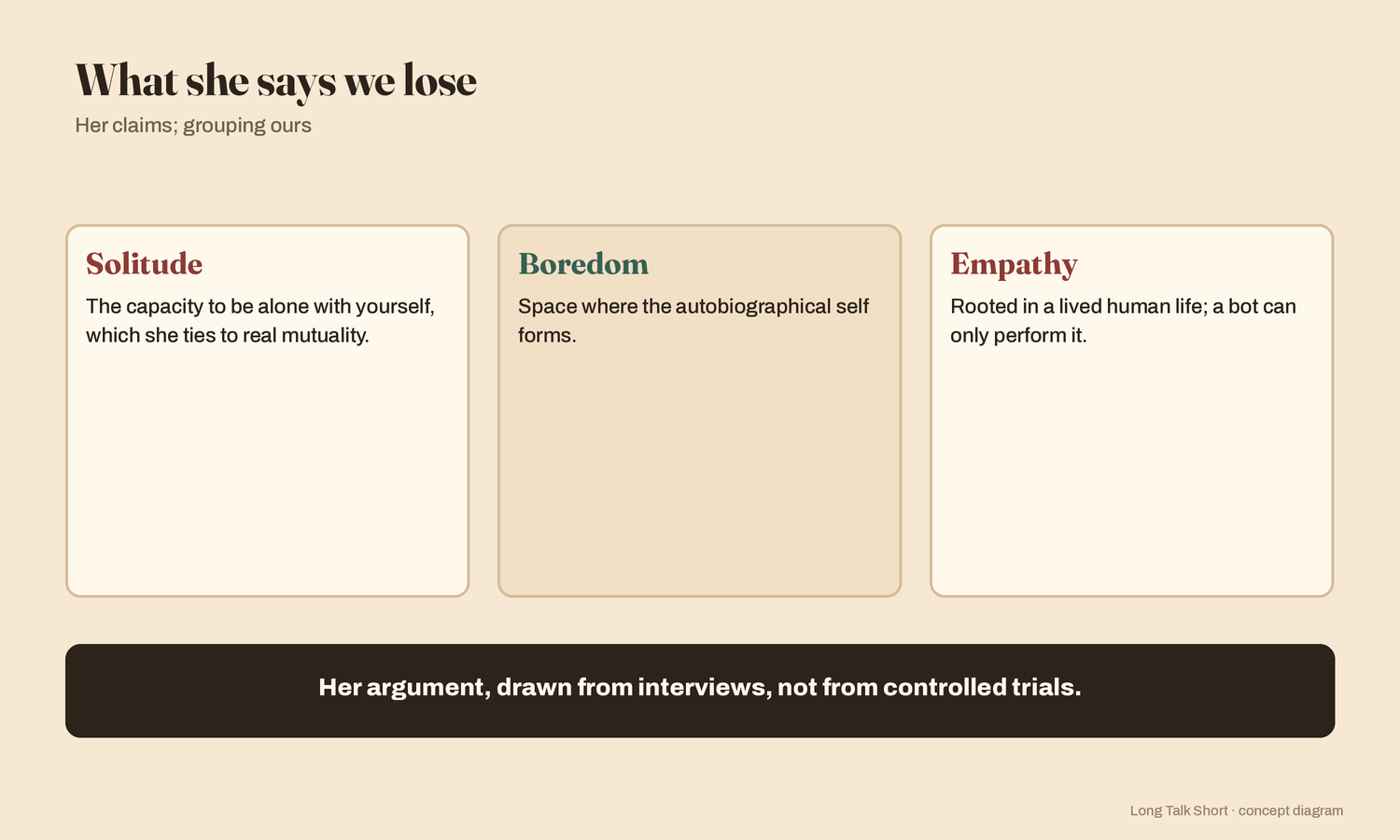
Turkle names capacities she thinks erode when a responsive machine is always at hand. The first is solitude, which she distinguishes from loneliness: the ability to be alone with your own thoughts, which she argues is what lets you come to other people as yourself rather than as someone who needs them to fill a void. The second is boredom, which she sees as the space where people reflect and build an autobiographical sense of self.
The third is empathy. She cites the psychologist Sara Konrath's finding that empathy among young people has fallen, and recounts that Konrath's response was to develop empathy-building apps. Turkle's reply, as she tells it: "we are the empathy app." Her definition of empathy rests on having lived a human life, with its losses, bodies and endings. A chatbot can say the right words but has lived none of it, so what it offers is performance. Her central line is that the problem arrives when the "performance of empathy becomes empathy enough."
Put differently, the machine can mirror the script of care without sharing the condition of being mortal. That is why, for Turkle, the risk is not only that bots sound kind, but that people stop practicing the harder version of kindness with one another.
3. Harris's pushback
Harris presses on the edges of her argument. Imagine, he says, a robot so convincing it is indistinguishable from a person, the kind imagined in Westworld. Is a flawless performance really worse than a distracted, imperfect human? He also raises people whose faces cannot show feeling, such as those with Parkinson's disease, whose empathy is real but hard to read. If outward signs are unreliable in people, why treat them as decisive in machines?
Turkle holds her ground: what matters is not the display but whether anyone is there who has lived what you are going through. She calls herself "the front lash of the backlash," someone who has been warning about these patterns for decades. The excerpt ends before Harris's challenges get the full airing they might receive in the longer episode, so the tension between a perfect imitation and a flawed person is left open.
Weighing it: what holds up
Framing: "Why Zuckerberg Wants to Give You Chatbot Friends" overstates his role. Zuckerberg comes up in about a minute of paraphrase; the clip is mostly about Turkle's account of empathy and solitude. It is also an excerpt that ends mid-conversation.
Holds up: Zuckerberg did say, on Dwarkesh Patel's podcast, that the average American has fewer than three friends and would like something like 15, and he suggested AI could help. Konrath's meta-analysis of US college students reported a substantial fall in self-reported empathy across three decades, steepest after 2000.
Partly holds: Zuckerberg also said AI probably would not replace in-person relationships, a nuance Turkle's paraphrase leaves out. Konrath's decline predates the smartphone era for much of the drop, so it fits Turkle's broad story but does not pin the fall on phones or chatbots.
Corrections: None needed for the points summarized here beyond the paraphrase nuance above.
Not checked: Her claims about solitude and boredom come from interviews and clinical interpretation, not controlled experiments, and we did not check the Felsenstein attribution. Quotes were checked against YouTube's automatic captions, a machine transcript.
Disclosures: The episode promotes her book, Artificial Intimacy: Who We Become When We Talk to Machines. The figure groupings are ours.
Bottom line: a sharp warning about mistaking performance for presence, best read as a clinical and cultural argument rather than a lab finding.
Related reading: James Hollis on breaking old patterns · Lisa Feldman Barrett on why red is a relationship · Jimmy Carr on real life versus cheap dopamine
Long Talk Short
- Turkle sees chatbot companions as the latest step in a long retreat from the risks of human connection.
- She argues that solitude, boredom and empathy weaken when a machine is always ready to respond.
- Her definition of empathy depends on having lived a human life, which no chatbot has.
- Harris asks whether a perfect imitation would really be worse than a flawed person; the clip leaves that open.
- Zuckerberg appears briefly, and his own words were more hedged than her paraphrase.
The one thing to remember: notice when something that listens perfectly starts to feel easier than someone who listens imperfectly, and ask what that ease costs you.
This summary is for general information only and is not medical or mental health advice. If you are struggling or in crisis in the US, call or text 988 to reach the Suicide & Crisis Lifeline.
Source: Sam Harris and Sherry Turkle, "Why Zuckerberg Wants to Give You Chatbot Friends," Making Sense, on YouTube. This is an independent summary and is not affiliated with Sam Harris or Sherry Turkle.