You Wanted a Backup Copy of Youth. The Shared Evidence Is Still Exercise, Sleep, and ApoB
A comparison of Sinclair, Huberman, Attia, and Johnson: they share exercise, sleep, diet, and ApoB, while the signature longevity pills remain weak. His 2026 doses are from commercial sources; the eye-trial data are company-reported. Not medical advice.
If you have been collecting longevity protocols the way other people collect supplements, a Sinclair clip can look like a shortcut: a “backup copy of youth” in every cell. It does not tell you which pills to buy. It is a 2023 lecture about gene therapy in the eye. The useful comparison is what Sinclair, Huberman, Attia, and Johnson actually share — and how thin the evidence is for the supplement aisle.
This article compares the public longevity protocols of David Sinclair, Andrew Huberman, Peter Attia, and Bryan Johnson, anchored to an X post of an excerpt from Sinclair’s April 2023 Majlis Mohamed bin Zayed lecture in Abu Dhabi, at x.com/i/status/2120471957443412213. The poster does not name the lecture. Where 2026 doses appear, they are as reported by NMN.com — a site that sells NMN — and a New York Post commerce article, written as claimed, not independently verified. This is not medical advice. Talk to a clinician who knows your case before starting, stopping, or combining a prescription drug or a high-dose supplement.
Disclosure: Sinclair co-founded Life Biosciences, the company running the ER-100 eye trial discussed below, so he has a commercial interest in that program. The dose writeups come from a retailer of one of the supplements in his stack and from a tabloid commerce article.
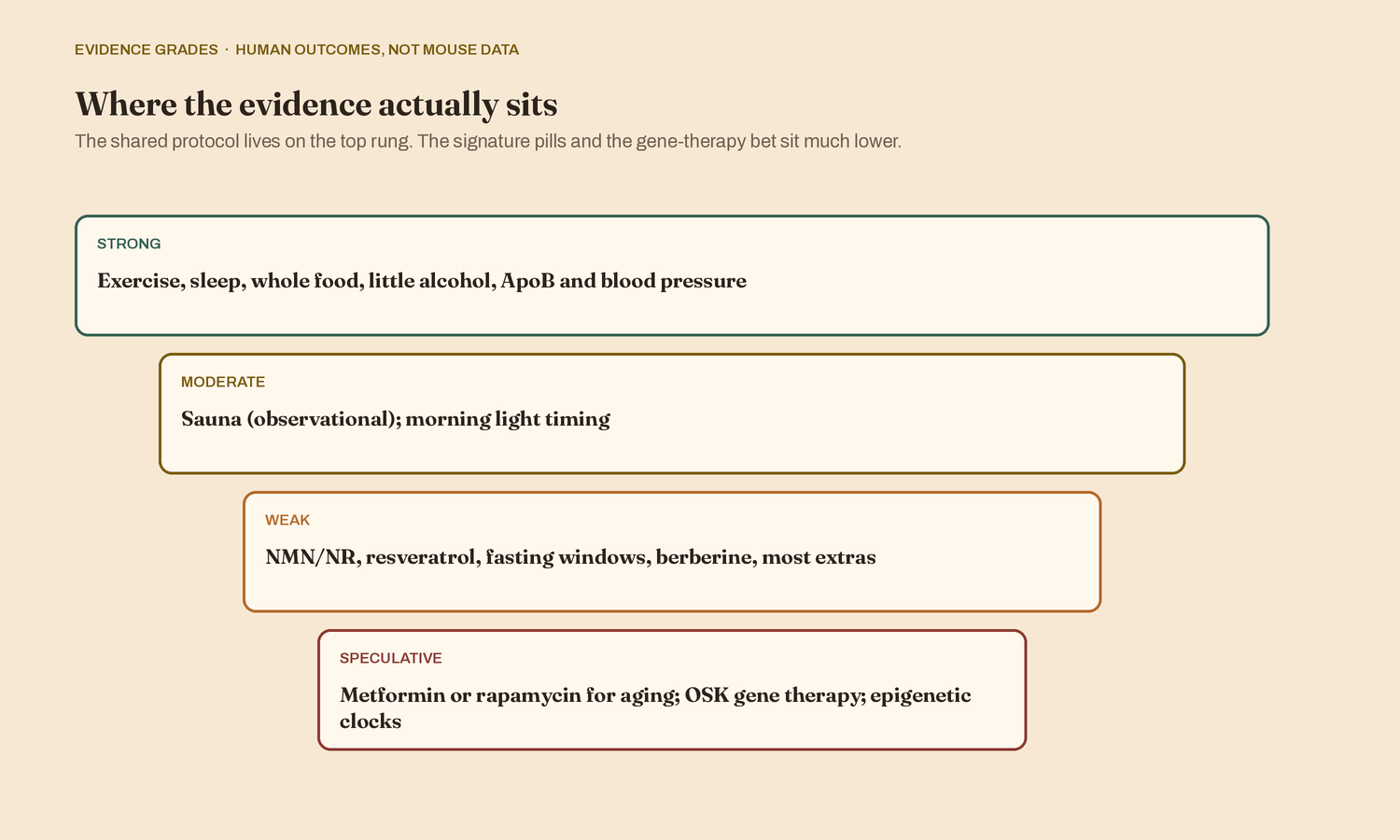
In short: the viral clip is a gene-therapy bet in the eye, not a supplement protocol. The strongest evidence the four men share is exercise, sleep, a mostly whole-food diet with little alcohol, and lowering ApoB and blood pressure. The signature pills have weak or speculative human evidence for slowing aging. Nothing here is a recommendation to start a drug or a dose.
1. What the clip is actually about
In the excerpt, Sinclair says there is “a backup copy of youth in every cell in our bodies,” and that a frail, sick older person has “corrupted software that needs to be reinstalled.” He forecasts treating a patient “in the next two years, if all goes well,” for “age reversal” and to “cure an incurable disease. In this case, it will be blindness.” That “backup copy” is partial epigenetic reprogramming with Oct4, Sox2, and Klf4 — OSK. A 2020 Nature paper from his group reported that OSK restored youthful DNA-methylation patterns and vision in old mice and in a glaucoma model.
The human step is not a pill, and not whole-body rejuvenation. Life Biosciences, which Sinclair co-founded, announced on June 9, 2026 that it had dosed the first participant in a Phase 1 trial of ER-100, an OSK gene therapy delivered to the eye. The trial record is an open-label safety study in optic neuropathies, with no masking. On October 8, 2026, the company reported that three people with open-angle glaucoma had tolerated a first, low dose through day 56, and that two showed visual-field gains — company-reported, unblinded, and from a study designed to test safety, not efficacy. Monkey vision results presented around the program are also company-reported and were not independently verified here. The “two years” forecast landed about three years after the lecture. Nothing on the market delivers it.
2. The protocol they actually share
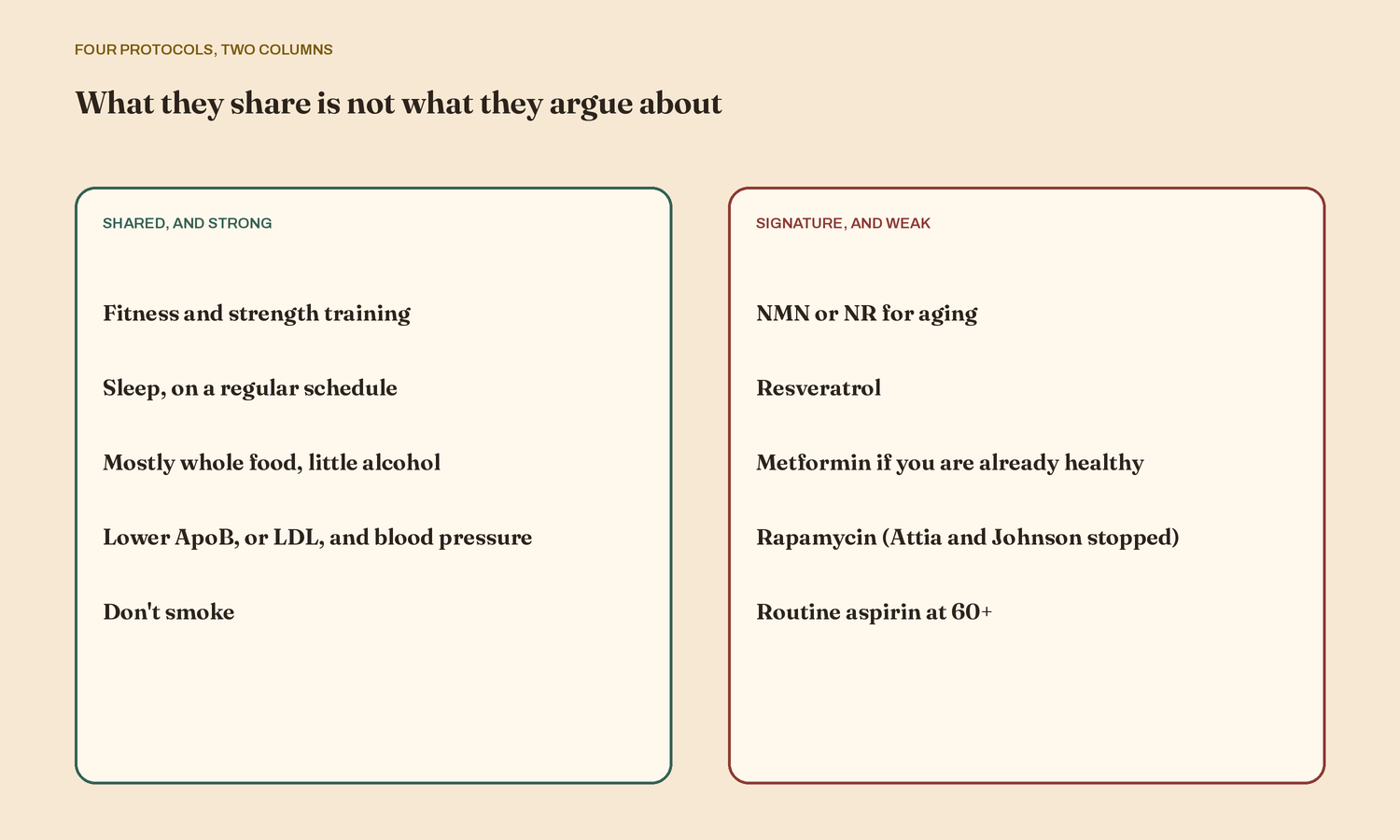
They disagree most loudly about pills. The strongest human evidence sits under what they all endorse: fitness and strength training, sleep, a mostly whole-food diet with little alcohol, not smoking, and lowering ApoB — and, relatedly, LDL cholesterol — and blood pressure. Those levers have large cohorts and, for lipid-lowering and blood pressure, outcome trials. ApoB counts atherogenic particles; LDL cholesterol measures the cholesterol they carry, so the two can diverge. Attia treats VO2max and strength as the top lever. Huberman’s public fitness protocol, as he has described it, centers on about 150 to 200 minutes a week of Zone 2 work plus three resistance sessions; Johnson has described about six hours of training a week; Sinclair exercises and skips metformin before workouts. Sleep is a cornerstone for Huberman and Attia. Sinclair’s reported 2026 stack does not headline it, which does not make it optional. On diet, he has described a mostly plant plate and alcohol a few times a year; the “stressed plants” idea is a hypothesis. Attia emphasizes energy balance and protein. The overlap is ordinary: mostly whole food, enough protein, and little alcohol.
3. The pills are the weak part of the stack
Sinclair’s signature molecules do not have strong human evidence for slowing aging. As reported in 2026, he takes 1 gram of NMN each morning and 1 gram of resveratrol with yogurt or olive oil, and he cycles 1 gram of metformin with berberine, skipping metformin before training. Those writeups specify 1 gram of metformin; the berberine dose is not clearly stated. NMN and NR can raise blood NAD+. Human trials have been small and short; one 2021 trial in 25 postmenopausal women with prediabetes reported a muscle insulin-sensitivity gain at 250 milligrams of NMN a day — not the 1-gram dose in the writeups, and not a lifespan result. The Interventions Testing Program did not find a lifespan extension from NR in mice, or from resveratrol. It did not test NMN in that program. Huberman has said he uses NR and NMN for energy, not as a lifespan drug. Long-term safety is unknown, and quality varies.
Metformin is an approved glucose-lowering drug. As a longevity drug in metabolically healthy people, the case is speculative, and the long-planned TAME trial had still not enrolled as of the coverage we checked; a ClinicalTrials.gov record for it was not found. Trials in older adults have found that metformin can blunt some training adaptations, including muscle hypertrophy in a resistance-training trial. An aerobic-training trial found a smaller VO2max gain that was not clearly statistically significant. Attia has stopped metformin, citing, among other things, its uncertain benefit in metabolically healthy people and its possible effect on training. Berberine can lower glucose in small trials, has no aging outcome data, and interacts with many drugs. Rapamycin is not in Sinclair’s reported stack. It has robust mouse-lifespan data and only small, short human studies. Attia stopped it, citing mouth sores; Johnson quit, citing infections, lipids, and glucose.
Low-dose aspirin, which those 2026 writeups say he takes most days, is not a general rule for healthy people. In 2022 the U.S. Preventive Services Task Force recommended against initiating low-dose aspirin for primary prevention in adults 60 or older. Sinclair, born in 1969, was 57 in 2026, so that 60-or-older grade does not apply to him directly; for adults 40 to 59 with elevated cardiovascular risk, the Task Force says the decision should be individual. He has said he takes it because of genetic heart-disease risk, a clinician’s call. The ASPREE trial, in healthy older adults, found more major bleeding and no heart-disease benefit. Stacking aspirin with nattokinase and fish oil, which those writeups also list, can raise bleeding risk. He has also been reported to take niacin for high Lp(a); adding niacin on top of a statin failed to improve heart outcomes in large trials, including AIM-HIGH.
4. A monitoring cadence, not a shopping list
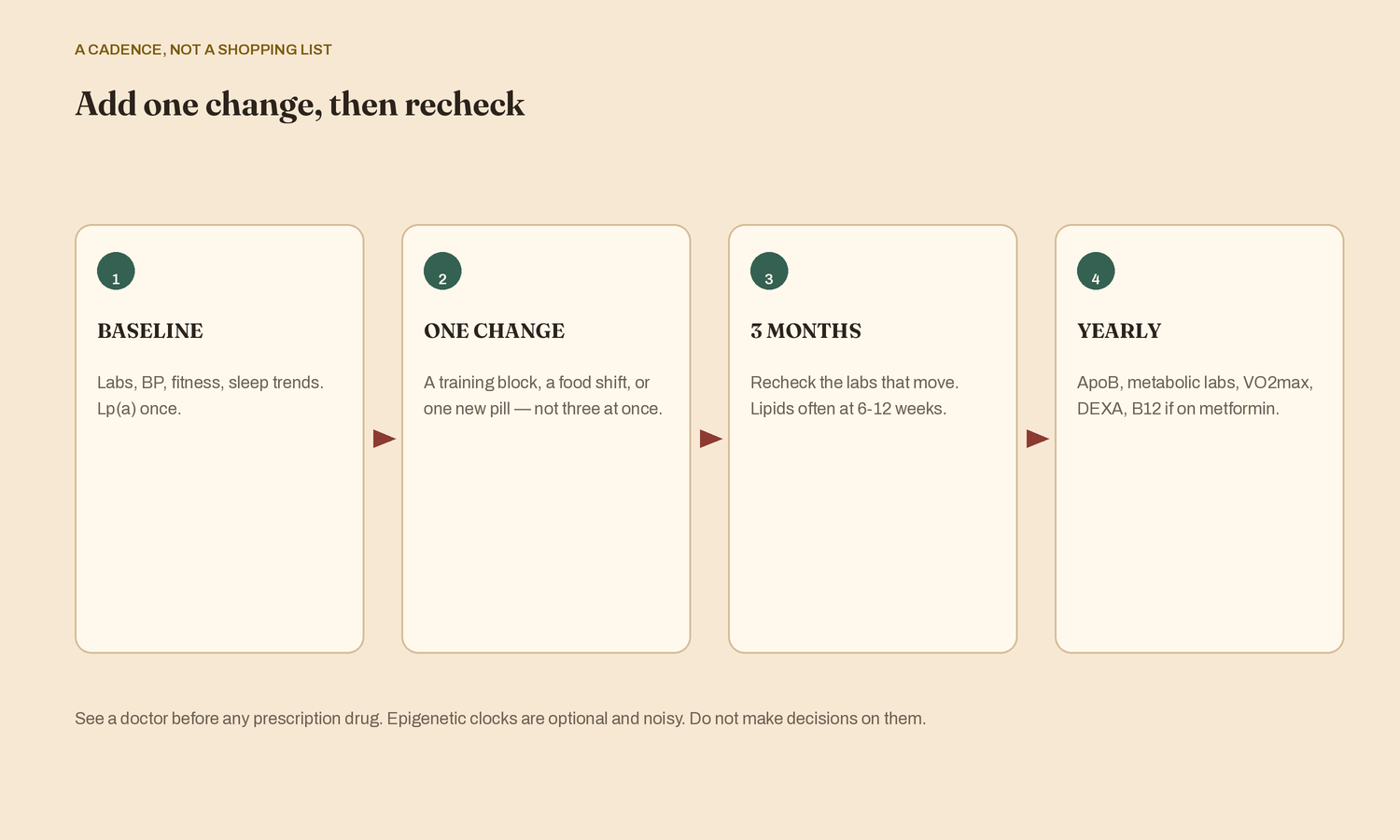
The comparison’s suggested rhythm, not a personal care plan, is baseline labs, one change at a time, a recheck at about three months — lipids often sooner — then yearly, with a clinician reading the results. The usual list in this literature is ApoB and a lipid panel, Lp(a) once, glucose and insulin markers, inflammation and organ-function labs if a drug or high-dose supplement is started, and B12 if metformin is used, plus home blood pressure, a consistent VO2max and strength check, and a training log. Epigenetic clocks are optional, noisy in individuals, and a poor basis for decisions. None of this is a recommendation to start a drug, a supplement, or a dose.
Weighing it: what holds up
The X clip is a 2023 vision statement, not a pharmacy protocol. The Nature 2020 OSK work, checked against the paper, is mouse vision data. ER-100’s first-in-human results were checked against Life Biosciences’ June 9 and October 8, 2026, releases and the trial record: an open-label, unblinded Phase 1 safety study in the eye, with early visual-field gains in two of three company-reported cases. Monkey results were not independently verified here. Sinclair’s 2026 doses come from self-report through a commercial NMN site and a tabloid commerce article; the berberine dose is not clearly specified, and the NMN insulin-sensitivity finding is from a small, short trial at a lower dose. The USPSTF 2022 aspirin recommendation was checked; it argues against initiating low-dose aspirin for primary prevention at 60 or older, which did not yet describe Sinclair, then 57. ASPREE is the trial cited for bleeding without heart benefit in healthy older adults. Metformin’s training effect is taken from the MASTERS hypertrophy trial and from an aerobic-training trial whose VO2max difference was not clearly significant. TAME had still not enrolled in the coverage we checked. This is not medical advice, and it is not a recommendation to copy anyone’s stack.
Related reading: Outlive in 5 Minutes · Can You Stand Up Without Your Hands? · Right About Sleep, Shaky on the Numbers
Long Talk Short
- The viral clip is about OSK gene therapy in the eye. Early human data are company-reported, unblinded, and limited to a Phase 1 safety trial.
- The strongest evidence all four share is exercise, sleep, a whole-food diet with little alcohol, and lowering ApoB and blood pressure.
- Sinclair’s signature molecules — NMN, resveratrol, metformin or berberine — have weak or speculative human evidence for aging. Huberman uses NAD precursors for energy, not lifespan. Attia stopped metformin and rapamycin; Johnson quit rapamycin.
- Low-dose aspirin for routine prevention in healthy people 60 or older goes against current USPSTF guidance; Sinclair was 57 in 2026 and has described his use as a personal, risk-based choice. His 2026 doses are self-reported through commercial sources.
The one thing to remember: If you want the part of these protocols that has human evidence, it is still the unglamorous one: train, sleep, eat in a way you can sustain, and get your heart-risk numbers treated — not a backup copy of youth in a pill.
Independent summary; not affiliated with David Sinclair, Andrew Huberman, Peter Attia, Bryan Johnson, Life Biosciences, NMN.com, or the New York Post. Not medical advice, and not a recommendation to start, stop, or dose any drug or supplement.
Source: An X post of an excerpt from David Sinclair’s April 2023 Majlis Mohamed bin Zayed lecture (linked above); Life Biosciences releases, the ER-100 trial record, the 2020 Nature paper, and the USPSTF 2022 aspirin recommendation are linked in the article. Independent summary; not affiliated with the speakers or the companies discussed.